

I love my grandmother’s macaroni and cheese. Like LOVE it.

The ingredients are simple enough (which I won’t disclose here 😉), and I spent much of my childhood standing in her kitchen watching her make it so I could recreate it when I went back home.
Those first few attempts on my own took some trial and error. I had the exact ingredients and followed the steps, and it was good. It still wasn’t quite hers. After a while, I understood the difference. Knowing the recipe mattered. Understanding how the ingredients and techniques worked together mattered even more as I adjusted the portions I needed to make.
Over time, it started to taste more like hers. And eventually, it became mine.
That process reminds me a lot of professional learning.
Instructional Design → Learning Experiences

Professional learning often provides teachers with strategies, activities, and protocols they can try the next day. These ideas are useful, especially when time is tight. Professional learning becomes even more powerful when educators have time to design and apply those ideas in their classrooms.
Instructional design turns standards and curriculum into learning experiences. It is where teachers decide:
- – the problem or challenge students will explore
- – the thinking the task requires
- – how students will demonstrate understanding
Through this process, strategies become purposeful tools within a larger learning experience.
Instructional design also builds coherence across a school. As educators shape learning experiences together, they develop shared language around:
- – engagement (click “Demo” to access a free reflection tool)
- – rigor
- – student ownership
This shared understanding strengthens alignment across classrooms and grade levels.
Instructional design also strengthens professional judgment. Teachers:
- – examine standards and expectations
- – consider the needs and strengths of their students
- – decide how learning will unfold
- – experiment, revise, and refine their work
Over time, they gain confidence to adapt lessons, respond to student thinking, and design learning experiences that are relevant and challenging for students.
Learn More
Professional learning grows stronger when it creates space for this work. Strategy lists spark ideas. Design turns those ideas into meaningful learning. When teachers have access to resources, examples, and structured opportunities to apply new thinking, ideas move more easily into classroom practice. This is the goal behind the professional learning resources we design at EdQuiddity.
Through our Professional Learning Experiences (PLEs), Virtual Learning Communities (VLCs), and the continually expanding resources in MyQPortal, educators explore new ideas while also having the tools and space to apply them in their classrooms.
 In this course, participants will leverage choice and technology to provide students with the ultimate differentiated learning environment. They will develop differentiated digital activity lists rooted in rigorous instruction that offer multiple ways to learn and apply content. Participants will explore autonomy, purpose, and mastery as motivators in all learning environments. They will design differentiated activity lists to put students in charge of their own learning, creating a structure that allows students to make decisions within a structured framework. Making informed decisions is an essential life skill that teachers can support with intentional classroom practices.
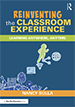 Participants in this course will use Reinventing the Classroom Experience by Dr. Nancy Sulla as a resource. The assigned book must be